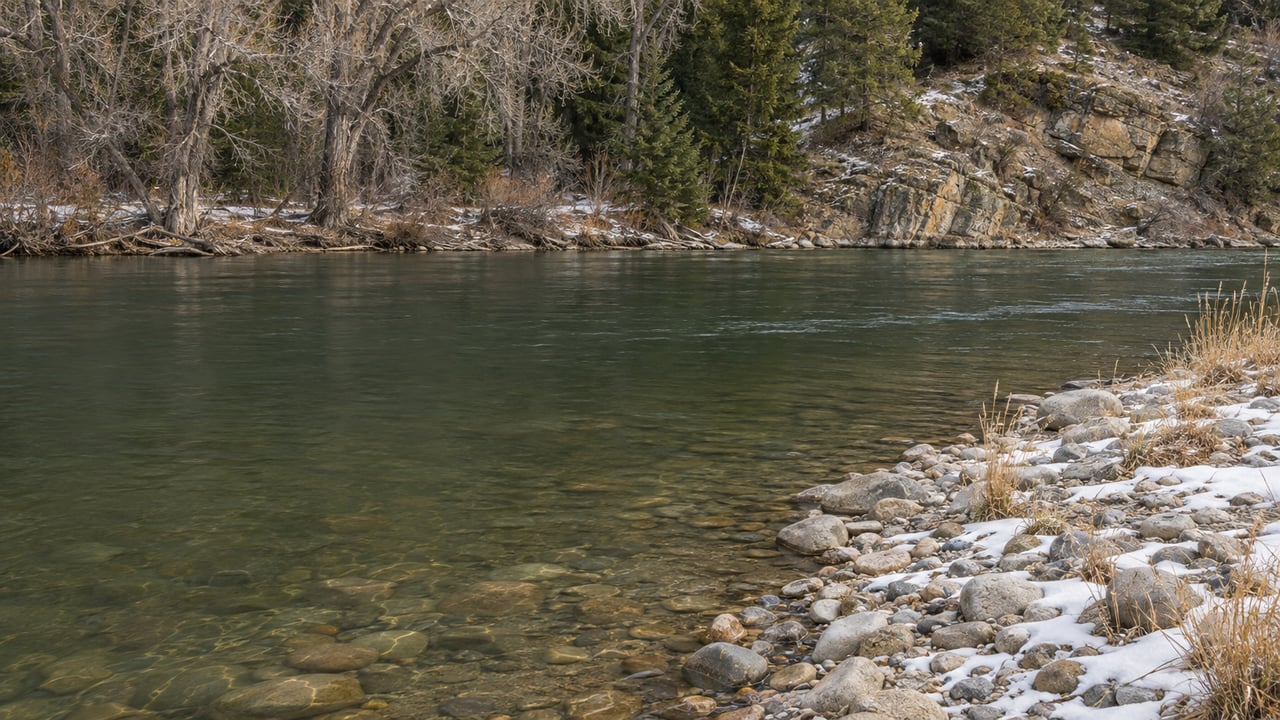
At 5:30 on the morning of November 16, the USGS gauge below Palisades Dam near Irwin read 912 cubic feet per second. That reading put the South Fork into winter. Two weeks earlier the river was still running around 1,400 cfs and the guide boats were finishing their season. By mid-November the release had reached the level the Bureau of Reclamation planned for the cold months. For anyone with a cabin along Swan Valley Highway, the river from here to spring is lower and clearer, it fishes best in the middle of the day, and outside the guided season the people fishing it are mostly the ones who live close enough to go when the sun is out.
The Release That Starts Winter
This year's numbers make the river's winter look more fragile than it is. In a September 21, 2026 report, Capital Press said the Upper Snake's eight storage reservoirs held 11% of capacity on September 18, slightly below the 2003 volume on the same date. Reclamation projected the system would end the irrigation season at 8% to 9% of capacity. For comparison, the median season-ending minimum since tracking began in the late 1970s is 38%.
The same report quoted Brian Stevens, Reclamation's Upper Snake water operations manager, saying that winter minimum flows would begin in the October to November period. Barring an extreme event such as an unusually big storm, he expected those flows to be normal, including 900 cfs out of Palisades. On November 16 the Irwin gauge showed almost exactly that. A near-empty reservoir system and an ordinary winter river are running at the same time this year.
The drop happened in steps. WorldCast Anglers' October 30 report put flows at 1,400 cfs, with clarity improving and fish moving toward slower water. The Lodge at Palisades Creek called its October 29 report the last weekly report of 2026, also at 1,400 cfs, and said it expected the river to fall to winter levels. The November 15 report from Fly Fish Food said flows had ranged from 925 to 1,400 cfs earlier in the month.
Check the Irwin Gauge, Not the Heise Gauge
Many fishing reports quote Heise. Fly Fish Food's November 15 report opens with 2,020 cfs at the Snake River near Heise, clear water and a gauge height of 2.04 feet. The USGS Heise gauge showed that same 2,020 cfs at 5:30 a.m. on November 16. That was more than twice the reading below the dam at the same hour.
Heise is well downstream, out past the canyon. For a Swan Valley angler deciding whether to walk down to the water near Palisades Creek or Spring Creek, the USGS gauge below Palisades Dam near Irwin is the number for the water they will actually stand in. The Heise gauge describes a different stretch of river. USGS labels both readings provisional and subject to revision.
A River That Fishes in the Middle of the Day
The winter river runs on a shorter schedule than the summer one. The Lodge at Palisades Creek says the South Fork fishes year-round as a tailwater, and its season calendar describes November through March as winter midges, with blue-winged olives on slow days. Its winter guidance says mountain whitefish make up most winter catches, especially on nymphs. The fly list runs from stonefly nymphs and San Juan worms to midges, bead-heads and streamers, and the guidance says the fishing is usually best from late morning into early afternoon, with midges rising on sunny days. That guidance was written in 2024, so it describes typical winter patterns, not this week's conditions.
This season's reports narrow those hours down. Fly Fish Food's November 15 report sets the midge window at 10 a.m. to 2 p.m. and the BWO window at 11 a.m. to 3 p.m. It calls the water clear and the fish educated, and it expects technical presentations, with BWOs as the main hatch. In late October, WorldCast Anglers said BWOs could bring fish to the surface on cool, cloudy days.
That is a short day by summer standards, but it suits someone who lives up the road. The best hours start after the coldest part of the morning and end well before dark. A resident can check the Irwin gauge over coffee, look at the sky, and decide by ten whether midges are likely. Most visitors don't have that flexibility.
Ramps From the Dam to Conant
The Bureau of Land Management's South Fork boating guide lists public concrete ramps at Palisades Dam, Palisades Creek at river mile 2.2, Spring Creek at river mile 12.2 and Conant at river mile 14.2. Conant, on Conant Valley Loop just off Swan Valley Highway, has a concrete ramp and a separate raft launch, according to BLM's Conant access page. The Lodge at Palisades Creek describes the Palisades Dam pool and Falls Creek Falls as features of the upper section from the dam to Conant.
In winter the hard part is getting there. In a February 2018 report, The Lodge at Palisades Creek wrote that in many winters the access lots are not plowed and the ramps can be dangerously slippery. In that low-snow winter, though, anglers could reach the river from Palisades Dam through Conant. Whether a lot is usable depends on the latest storm, so check the turnout before you load the boat.
The guided season is mostly over too. The Lodge at Palisades Creek runs its lodge from May 1 through October 31, and its day trips and fly shop visits run from April through November. Its October 29 report asked readers to call about winter day trips. If you want a guided winter float, call an outfitter directly and confirm dates before planning around one.
Where the Rainbow Heads Go After September
Idaho Fish and Game runs the South Fork Snake River Rainbow Trout Harvest Incentive Program, which puts cash prizes on tagged rainbow and hybrid trout taken from the river. The agency calls the South Fork one of the last major conservation strongholds for Yellowstone cutthroat, Idaho's state fish, and says the cutthroat are declining from hybridizing and competing with non-native rainbows.
Each year about 1,000 rainbow and hybrid trout are tagged with coded wire in the snout and released. A tagged fish is worth $50 to $1,000. In summer, anglers can leave heads in the freezers at the Conant and Byington boat ramps, but those freezers run only from May through September. From now until spring, heads go to the Fish and Game regional office in Idaho Falls, Monday through Friday from 8 a.m. to 5 p.m. Anglers who want to watch staff scan their fish can bring heads on the first Friday of each month for the live scan event. The first one this winter falls on December 4.
Watching the Cliffs Between Hatches
On a winter day there are long gaps between hatches, and the canyon walls are worth watching. Idaho Fish and Game names the cliffs along the Cress Creek Nature Trail, which overlook the South Fork, as a reliable place to see bald and golden eagles. BLM counts 126 bird species in the South Fork corridor, 21 of them raptors.
As of mid-November, with the Irwin gauge near 912 cfs, clear water and a hatch window from late morning to mid-afternoon, the South Fork near Swan Valley is a winter river for anyone who can get to the water on short notice.
If your favorite run sits within walking distance of your cabin, Mel Biggs and the team at Mountain West Luxury Living know the South Fork corridor well, from the dam to Conant, and are glad to talk about owning on the river in Swan Valley. Schedule a free consultation whenever you're ready.